Standard bodyweight yoga is great. Until you want it to be harder.
As a runner, I live for the burn. The good kind. The kind that happens after 20 miles. But when I roll out my mat, or step into a Pilates studio, the challenge usually hits me in flexibility, not strength. I’ve tried everything to bridge that gap. Resistance bands are boring. Traditional iron dumbbells are dangerous—I once clattered one so hard against my hip I swore off free weights in my yoga practice permanently.
That’s how I found myself buying a pair of Bala Bars dumbbells.
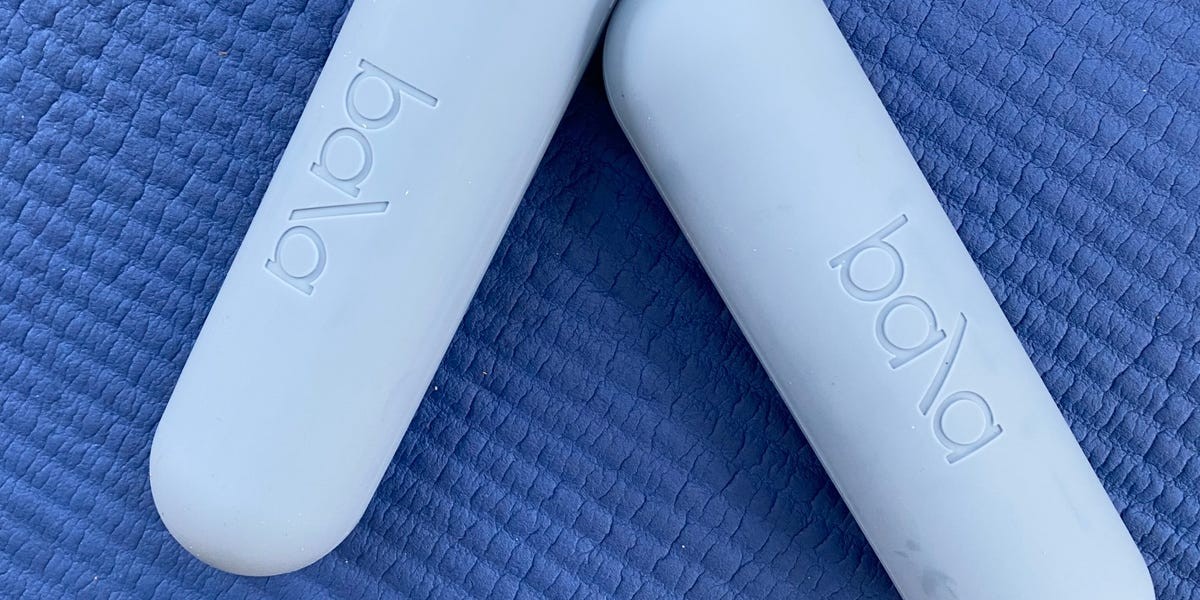
They look like expensive glow sticks. They’re coated in silicone. They don’t weigh much. And somehow, they solve the specific problem of “I want resistance but I don’t want to break my house or myself.”
Are they worth the steep price tag? It’s complicated. But if you’ve ever wondered why lightweight weights feel pointless, the answer might be in how you hold them, not what’s inside them.
How Bala Bars Feel vs. Traditional Dumbbells
Let’s get the obvious part out of the way first. They are pretty.
I bought the colorful ones because I wanted equipment that didn’t look like garage junk. There’s something about nice aesthetics that tricks your brain. I wanted to use them because they sat on my desk like art pieces, not tools.
But the form follows function here. And actually, pretty good.
Most dumbbells have a heavy center and light handles. It’s fine for curling biceps. It is terrible for flow. In yoga or barre, you move slowly. You hold positions. When weight is uneven, your stabilizing muscles have to work overtime just to keep the object still, distracting from the muscle you’re actually trying to train.
Bala Bars solve the “hip-bang” factor while offering a distributed weight that feels natural in fluid movements.
The silicone coating on the Bala Bars changes everything. It’s soft but dense. Not squishy. I was skeptical. My hands sweat. A smooth cylinder should slide out of my grip during a Warrior II hold.
It didn’t.
The grip stayed secure even when I was glistening with exertion. The shape is compact. It fits a small hand and a large one equally well. More importantly, it has no hard edges. I swung it between a Plank and an Overhead Press without fear. I never hit a kneecap. Never heard a thunk against the hardwood floor. That psychological safety changes how you move. You’re not guarding your furniture. You’re moving through the range of motion.
Why 3 Pounds Feels Heavy in Barre and Pilates
Here is where most people misunderstand these.
If you try to use Bala Bars for traditional bicep curls, you will be bored. The heaviest option is 3 pounds. Some might buy the 1lb or 2lb version.
For hypertrophy? Useless. For a heavy squat session? Ridiculous.
But this isn’t heavy lifting. This is resistance addition. Think of it like a weighted vest. You aren’t asking the vest to lift your legs. You’re asking your body to lift its usual weight plus the vest.
When I added them to Yoga Warrior poses, the burn shifted. It wasn’t my quads screaming; it was my shoulders and stabilizers realizing they had to hold 6 pounds total in static suspension. In a Barre class, where reps are high and weights are low, these were superior to the cheap rubber weights the studio provides.
One classmate asked me where I got them. She noticed I was moving faster. That’s the thing. Light, even resistance forces efficiency. If the weight wobbles, you slow down to control it. The tube shape of the bars keeps the weight steady, allowing for cleaner, faster repetition without the safety pause.
I even took them home for Pilates. The Boat pose suddenly became a core-shredder. It wasn’t the weight itself. It was the fact that I had to maintain that core tightness while holding the bars steady at a slight distance from my torso. It changed the lever arm.
Are Bala Bars Better Than Silicone or Adjustable Alternatives?
Let’s talk about the elephant in the room. Or rather, the price.
Bala Bars run between $40 and $59 per pair. That feels expensive for 3 pounds of material. It absolutely is.
Do you need this specific brand? Probably not.
AlterNAbody makes silicone weights that you can screw together for adjustment. Resistance bands are dirt cheap. If your budget is tight, those are valid alternatives. You just sacrifice the uniform distribution and the “cool factor.”
If 3 pounds is still not enough, Bala doesn’t save you there. You’ll need to look at adjustable dumbbells like the Nuobell. Those range from 5 to 50 pounds. But they’re huge. They take up space. And they definitely bang against your hip.
The carrying case for Bala Bars is small enough to slip into any gym bag. They’re portable. They’re discreet. You can throw them on a mat in a park. No one will think you’re a menace.
The Final Verdict
If you are a powerlifter, scroll past.
If you are doing bodyweight training and feeling that familiar plateau—the strength has caught up to the workout, and nothing is challenging your arms or stabilizers—this is a fix.
Bala Bars are well-made. The silicone lasts. They look good, which keeps you using them. The even weight distribution makes complex movements possible without injury risk.
Is $50 worth it? For a single tool that upgrades three different types of low-impact exercise without cluttering your living room? Yes. It’s an investment in consistency.
Consistency pays off. Eventually. Even if the weight feels light.