


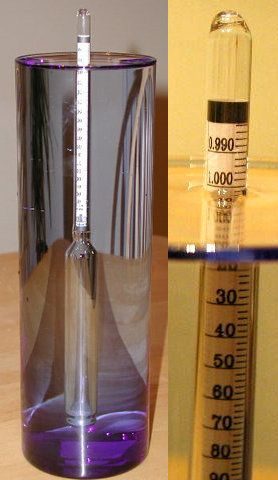
Most homebrewers know what to do. Before starting fermentation, it is necessary to measure the hydrometer. When the bubbling stops, measure again. Enter these numbers into the calculator. The result is ABV (alcohol by volume).
But how does the math work in practice? Why is there such a big difference between the “3.2%” beer sold in the supermarket and the “5%” beer sold in the liquor store?
It all depends on the density. More precisely, it is the specific gravity.
The Science of Gravity and Wort
水的基线密度为每升 1 千克。 我们将其定义为比重 1.0。 啤酒麦芽汁——发酵前从发芽谷物中提取的甜味液体——比水重。 它在 1.06 的刻度上浮动,因为它充满了溶解的糖。
酵母进入混合物并吃掉这些糖。 它产生什么? 酒精和二氧化碳。
酒精比水轻。 其密度约为0.79 kg/L。 二氧化碳是一种主要逸入空气中的气体。 当酵母将糖转化为这些较轻的副产品时,液体的整体密度就会下降。
最终比重将始终低于起始比重。 这一下降是释放酒精含量的关键。
The Chemical Equation
To understand this change, we need to look at molecules. The main sugar consumed by yeast is glucose (C6H12O6). In yeast cells, one glucose molecule is split into two ethanol molecules and two carbon dioxide molecules.
C6H12O6 => 2(CH3CH2OH) + 2(CO2)
Molecular weight is important here. The weight of ethanol is 46.0688 g/mol. The weight of carbon dioxide is 44.0098 g/mol.
The reaction produces two of each, so the ratio is constant. For every 44.0098 grams of carbon dioxide that leaves the container as bubbles, 46.0688 grams of alcohol remain in the beer.
Base your calculations on this ratio. Around 1.05.
For every loss of carbon dioxide, 1.05 grams of alcohol is produced. This constant is the bridge between what you measure and what you drink.
Calculate ABV based on Gravity Points
Let’s look at a real example. Imagine that the starting weight is 1.06. Final gravity is 1.02.
- Find the difference: 1.06 minus 1.02 is 0.04.
- Converting to mass: This 0.04 represents a density change of 0.04 kg/L. This figure is directly related to the loss of CO2, as the decrease in density is due to the loss of sugar and the increase in light alcohol/CO2.
- Apply the ratio: Multiply 0.04 by 1.05. Based on the mass, 0.042 kg/l of alcohol is obtained.
- Calculate the percentage: Divide the mass of the alcohol (0.042) by the final mass of the solution (1.02).
0.042 / 1.02 = 0.041.
The alcohol content is 4.1%.
Mass vs. Volume: The Confusion
对于消费者来说,事情变得棘手。 质量酒精与体积酒精不同。
酒精的密度比水小。 一升酒精的重量小于一升水。 因此,给定质量的酒精比相同质量的水占据“更多”的空间。
要将质量百分比转换为体积百分比,请除以酒精的密度 (0.79)。
4.1 / 0.79 = 5.19。
因此,按质量计 4.1% 的啤酒实际上是按体积计 5.2% 的啤酒。
“3.2 啤酒”之谜
这种转变解释了美国酒精法的历史怪异。 在科罗拉多州等州,杂货店一度只允许出售“3.2 beer”。
法律将酒精含量上限按质量计 控制在 3.2%。 这是一个漏洞。
如果将质量百分比 3.2 转换为体积:
3.2 / 0.79 = 4.05。
杂货店里的“淡”啤酒的酒精度实际上是 4%。 与此同时,酒类商店的啤酒按体积标记,酒精度通常为 5%。
差异很大,但并不像标签所暗示的那么极端。 质量与体积的转换隐藏了显而易见的强度。
了解比重计读数背后的chemistry会改变您对啤酒的看法。 这不仅仅是神奇的数字。 这是密度、化学和一点法律漏洞。 下次倒酒时,想想CO2 that left and the alcohol that stayed。

