


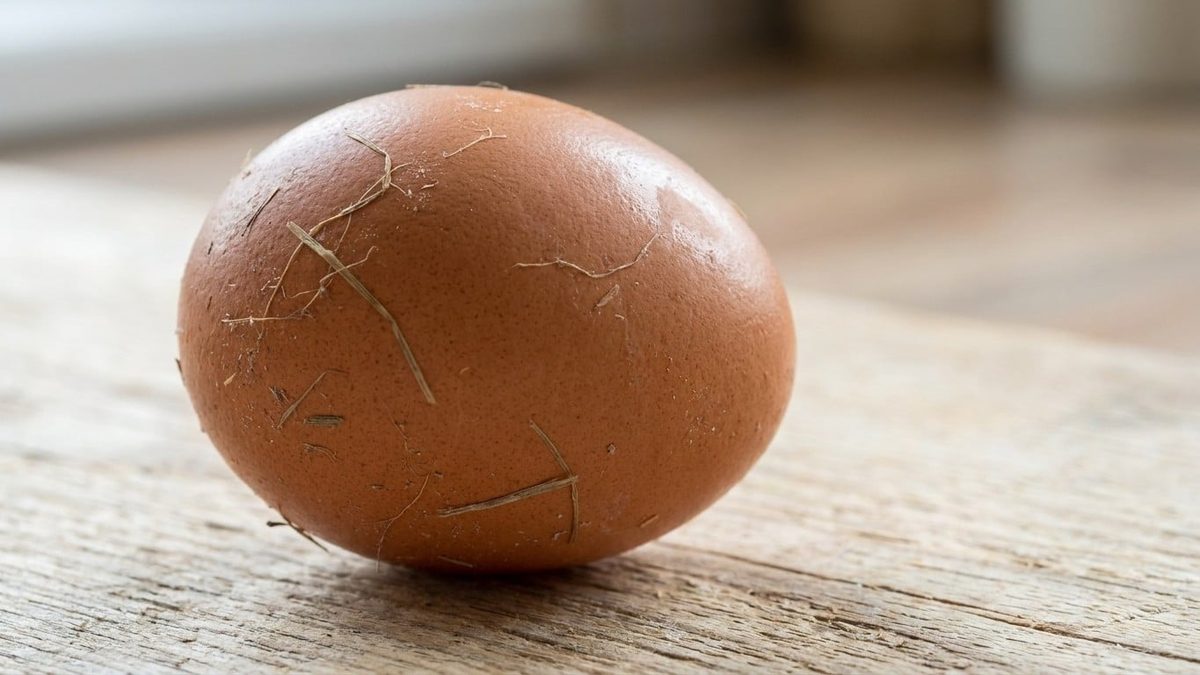
There is a specific, visceral panic that hits when you pull a carton of eggs from the fridge and notice a speck of dirt on the shell. It’s small. It’s unsightly. And your instinct screams for the sponge.
You grab it. You wet it. You wipe.
In three seconds, you have undone decades of biological engineering. You haven’t just cleaned the egg. You’ve dismantled its only real defense.
This isn’t a paranoid tip from a back-to-nature blog. It’s basic biology codified into European law. That tiny smear of dried manure is less dangerous to your health than the water you’re using to remove it.
The Invisible Shield You’re Scrubbing Away
Every egg comes with a built-in force field. It’s called the cuticle.
When a hen lays an egg, she secretes a thin, waxy film over the shell in the final hours of formation. This layer seals between 7,000 and 17,000 microscopic pores. Think of these pores as open windows. Without the cuticle, the egg is breathing in everything around it—bacteria, moisture loss, environmental contaminants.
The cuticle is a mechanical and antimicrobial barrier. It blocks pathogens like Salmonella and E. coli from entering the shell. It’s molecular chainmail, applied by the hen herself.
Joël Gautron, a research director at INRAE who specializes in eggs, describes it as a natural biofilm. It’s invisible. It’s slightly waxy if you know how to feel for it. It regulates gas exchange and stops the egg from drying out.
This is why a farm-fresh egg can sit on your counter for three weeks without turning toxic. The cuticle keeps the bad guys out. The egg white helps too, containing proteins like lysozyme that attack bacteria. But it’s a layered system. If you remove the first layer, the whole defense collapses.
The Physics of Contamination
Water destroys the cuticle irreversibly.
When you run an egg under the tap, even with warm water, you strip that waxy coating. The shell becomes porous again. But it gets worse.
If the water is colder than the egg—which it almost always is in a kitchen sink—a suction effect occurs. The water cools the contents of the egg slightly, creating a vacuum that literally pulls bacteria from the surface into the egg through those open pores.
You are not cleaning the egg. You are injecting contaminants into it.
An egg with a bit of dirt on an intact cuticle is microbiologically safer than a washed one. The dirt is outside the seal. The bacteria you’ve sucked in are now inside the protein.
An egg slightly soiled but with an intact cuticle is microbiologically safer than an egg that has been washed.
There’s also the splash factor. Washing eggs under running water creates microscopic droplets. These can carry bacteria from the shell and spray them onto your sink, your counters, or your lettuce. The shell becomes a catapult for germs.
Why Your European Supermarket Doesn’t Wash Them
If washing seems like a good idea, check your local laws. In Europe, washing eggs sold to consumers is illegal.
This isn’t a gentle suggestion from the government. It’s a strict prohibition. The European Union mandates that eggs be kept clean through hygiene in the henhouses, not by cleaning the eggs themselves. The goal is to keep the cuticle intact.
The approach differs wildly from the United States.
In the US, eggs are washed. This removes the cuticle. To compensate, the US system relies on mandatory refrigeration from farm to store to prevent bacterial growth. If you see unwashed eggs on a non-refrigerated shelf in an American supermarket, that would be a health code violation.
In Europe, because the cuticle remains, eggs are stable at room temperature for short periods. They don’t need to be chilled until they reach the consumer.
The Real Risk
The stats are sobering. According to Anses, eggs are linked to 39% of food poisoning outbreaks in France. In 2023, nearly 12,000 cases of salmonellosis were officially reported. The actual number is likely much higher, as many mild cases go unreported.
We can’t blame every case on home washing. But the data shows that eggs are a high-risk food. They don’t forgive mistakes.
So, what do you do with that speck of dirt?
Leave it.
If the egg is really dirty, you can gently brush off loose debris with a dry cloth or paper towel. Do not use water. Do not use soap. Just keep the shell intact.
Store the eggs in their original carton in the coldest part of your fridge, not the door. The door is too warm and the eggs get jostled. The carton protects them from odors and moisture loss.
Cook them thoroughly. Over 70°C kills most pathogens.
It feels counterintuitive. We are conditioned to believe that clean means washed. But in the case of eggs, cleanliness is a structural property, not a cosmetic one.
The dirt on the shell is a badge of natural production. The water you use to remove it is a vector for contamination.
Keep the cuticle. Trust the biology. And maybe, just maybe, stop scrubbing the things you eat.
The Naked Truth About Dirty Shells
Here is the scenario you actually care about. You bought eggs from a farmer’s market or a local farm. They are dusty. Maybe there is a bit of straw, or worse, a tiny speck of poop. The instinct? Run them under the tap. Stop. Don’t do it.
The answer is surprisingly simple: use a dry cloth. Or a paper towel. Just wipe it.
This dry cleaning method removes visible debris without stripping away the shell’s natural protective layer—the cuticle. Wetting the shell is a mistake. It dissolves that cuticle. It introduces moisture. And moisture is basically a VIP pass for bacteria to migrate through the porous shell and into the egg white. If you have to wipe a dirty egg right before you crack it into the bowl, fine. But eat it immediately. Don’t save the rest. Minimize the risk by minimizing the time it spends exposed.
The Refrigerator Trap
We’ve been lied to about egg storage. Or at least, the rules depend entirely on how clean those eggs were when they left the hen.
In many places, commercial eggs are washed. This removes the cuticle. To compensate, they are often sprayed with a mineral oil coating. These eggs go straight into the fridge. The cold keeps them safe.
But farm eggs? The unwashed ones? They are different. Putting a dry, unwashed egg in the fridge creates a problem called condensation. You pull the egg out. The room is warmer than the fridge. Moisture forms on the shell. The cuticle softens. The bacteria get to work.
The rule is brutal in its simplicity: keep unwashed eggs in their original carton. Store them in a cool, dry cupboard. Room temperature is fine. In fact, it’s preferred. Avoid the refrigerator door. It’s the worst place in the kitchen. The temperature fluctuates every time you reach for milk or cheese. These thermal shocks weaken the shell’s integrity. Keep it stable. Keep it dry. Keep it out of the fridge if you haven’t washed it.
The Bitter Warning in Your Garden
Speaking of things you shouldn’t ignore, let’s talk about summer squash. Specifically, the zucchini.
If you garden, or if you grow zucchini at home, you need to pay attention to something called cucurbitacin. It’s a toxin. It develops when zucchini plants cross-pollinate with ornamental gourds. This happens more often than you’d think in family gardens. The plants are close relatives. They swap pollen. The result? A zucchini that looks perfect. Smooth skin. Bright green. No visible rot.
But it tastes bitter.
That bitterness is not a flavor profile. It’s a warning shot. It’s a chemical alarm bell ringing in your mouth. If you bite into a zucchini and it makes you wince, spit it out. Do not eat it. Do not cook it to “fix” the taste. Cooking doesn’t destroy cucurbitacin.
This isn’t a theoretical risk. In France alone, this causes several serious poisoning cases every summer. People get sick because they assumed the bitter taste was just a bad batch. It’s not. It’s nature telling you to stop. Unlike a dirty egg, where the danger is invisible and requires dry wiping to manage, a bitter squash screams for your attention

