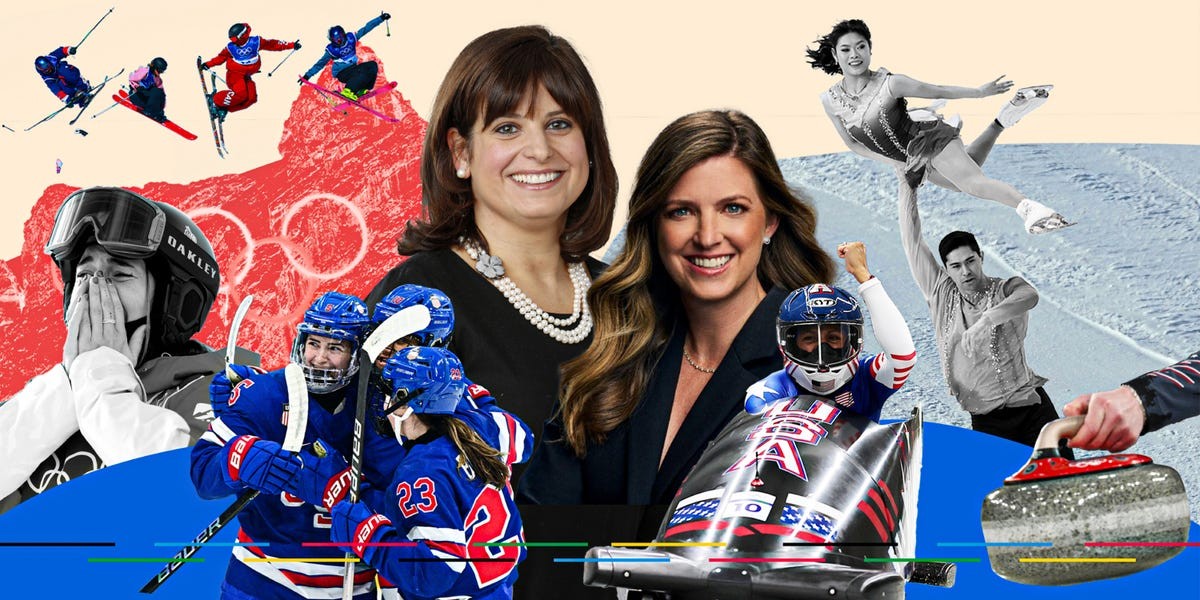
The Winter Olympics in Italy are delivering the spectacle viewers expect – thrilling competition, emotional victories, and high-stakes drama. But the seamless broadcast reaching millions of American homes doesn’t just happen. Behind the scenes, a massive operation unfolds, with over 1,600 staff members working around the clock to turn athletic feats into polished primetime entertainment.
The logistical scale is immense: trucks shuttling crews, shipping containers packed with gear arriving months in advance, and teams scouting locations a year ahead. Broadcast feeds stream from venues worldwide, undergoing constant monitoring and editing to ensure a flawless on-air experience. Yet, much of this orchestration is quietly managed from an ocean away, thanks to two key executives based in Stamford, Connecticut.
Betsy Riley, Senior Vice President and Coordinating Producer, and Rebecca Chatman, Vice President and Coordinating Producer of Olympic Production, are the unseen architects behind NBC’s primetime coverage. Their days stretch to 18 hours, problem-solving in real-time and ensuring every shot, segment, and story lands perfectly on screen.
Running the Biggest Show in Sports
The job is inherently chaotic. Plans shift with weather cancellations, talent illnesses, and unexpected stories taking precedence. The Stamford hub functions as the nerve center, with hundreds of staffers working nearly non-stop to adapt. As Chatman puts it, “We plan something for three years, and then every day we have to react and be ready to change our plans.”
Riley succinctly describes her role: “When you turn the TV on at 8 o’clock, that is the show I’m responsible for leading.” She oversees tape editors, graphics, research, creative teams, and on-air talent, all collaborating to shape the nightly broadcast. The key, both executives agree, is agility. “We go into each day with a plan, and then sports happen and weather happens and we have to adjust,” Riley says.
Small production choices can make a big difference. One recent example: when Olympic bobsledder Elana Meyers Taylor celebrated a gold medal using sign language with her children, the team swiftly added subtitles for primetime viewers, creating a more intimate and inclusive moment for millions at home.
Constant Problem-Solving Under Pressure
Daily crises are inevitable. Whether it’s logistical reshuffling, talent emergencies, or technical hiccups, the goal is to resolve issues so seamlessly that viewers remain unaware. “You’re trying to make sure that the viewer at home doesn’t see it,” Chatman explains. “There’s never just one day where everything goes exactly as planned.”
The demands are extreme. Chatman typically starts her day around 3 or 4 a.m., while Riley works from 9 a.m. to after 2 a.m. Sleep is sacrificed, but both find a strange manageability in witnessing extraordinary athletic moments. “You don’t feel completely exhausted because you get to see these incredible moments,” Chatman says.
To cope, both prioritize physical and mental recovery. Chatman, a regular Barry’s Bootcamp attendee, admits that her routine vanishes during the Games, so she focuses on stretching and winding down with light reading before bed. Riley treats the weeks leading up to the Olympics like an athlete preparing for competition: “I try to come into the Olympics really healthy,” she says. “I try to make sure that I’m getting a lot of fitness in.”
Paving the Way for Future Generations
Both Riley and Chatman took unconventional career paths. Riley transitioned from finance to sports production after covering the 2004 Athens Olympics, while Chatman leveraged an internship at an NBC affiliate. Their advice is simple: pursue your passions and demonstrate value.
Historically, sports television has been a male-dominated field. Both executives recall being among the few women in leadership positions. Riley remembers “many, many years where I was the only woman in the front of the truck.”
The landscape is shifting, with more female directors, analysts, and voices emerging. This change informs their leadership style. Chatman emphasizes mentorship, recalling how others helped her navigate the industry. “Once I moved into this role, it really started to dawn on me how representation matters,” she says.
Riley prioritizes inclusion and diverse perspectives. “I really love to have a diverse group of voices at the table pitching ideas… we strive to create an interesting production, and that doesn’t come from having people who all look alike and think alike.”
Success Beyond Ratings
Riley defines success by “team vibe,” emphasizing collaboration and psychological safety. She encourages bold ideas, even “crazy” ones, fostering an environment where team members feel empowered. Chatman focuses on personal contentment and contribution, finding fulfillment in her work.
Ultimately, their work is invisible to the viewer. As Chatman puts it, “If you see me on TV, there’s a really big problem.” Their goal is to elevate the athletes, stories, and events – remaining anonymous so the spotlight remains where it belongs.
“The Olympics just so special. There are so few events that just bring people together.”
This dedication to behind-the-scenes excellence ensures that when the show comes on at 8 p.m., the focus remains squarely on the athletes and their extraordinary journeys.