


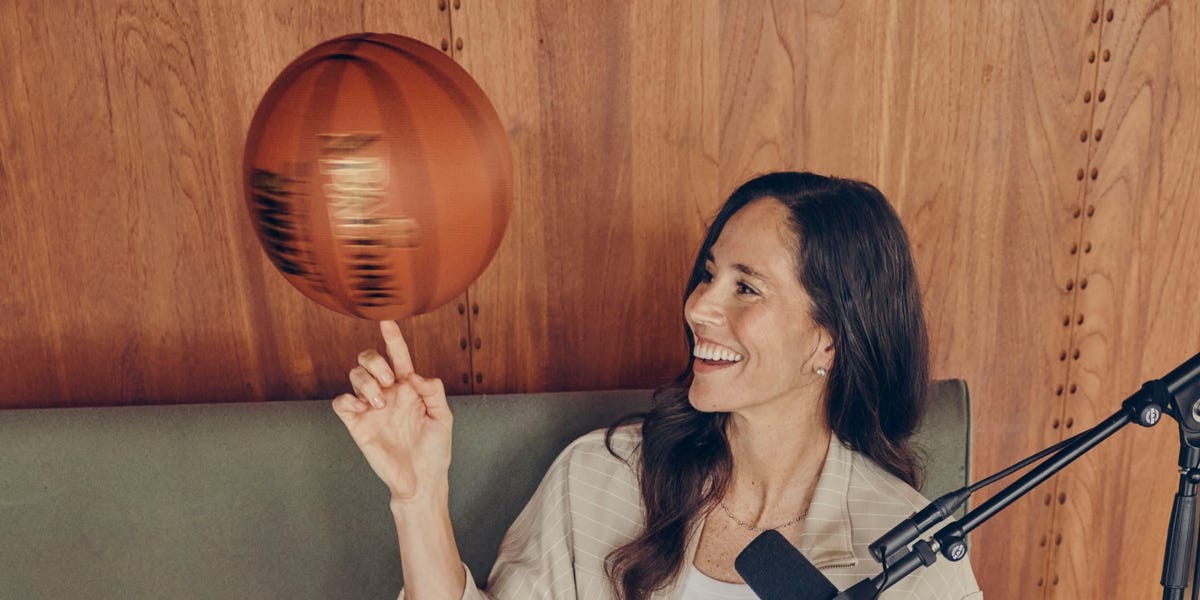
Sue Bird gets a strange greeting.
In Seattle—where she’s lived since 2002—the vibe is neighborhood casual. ” ’Sup, Sue?”
She’s everywhere there. A statue welcomes fans to Climate Pledge Arenas. Storm staff keep her memorabilia in offices. She is always present even when absent.
New York is different.
Some days she’s invisible. Others, she stops four times before dinner.
Travis, a fan, corners her at a West Village lunch in April. “I’m Travis,” he says, beaming. “Congrats on the success. Podcast. Togethxr. Huge respect.”
“Thanks,” Sue says, warm for a beat, then dropping into deadpan. “Good for the interview though, Travis.”
I made the same mistake earlier that afternoon. “Congrats on the job.”
She looked at me. Puzzled.
I meant the NBC Sports analyst gig. Signed last week. Tiny surface scratch of her current chaos.
“People come up saying congrats and you don’t know what they mean?” I ask later. “That means you’re doing something right,” she notes.
Four years post-retirement, the point guard is navigating the perimeter again.
We know the resume: Naismith Hall of Fame. Two UConn titles. Four WNBA rings. Five Olympic golds. Record-setting.
But right now?
She’s on your TV. She’s in your ear via Bird’s Eye View. She’s moving capital through Togethxr and Deep blue Sports + Entertainment to lift women’s sports. As Managing Director for the U.S. National Team, she picks who runs the floor for Los Angeles 2028.
She is far enough from the game to see clearly. Close enough that player and person bleed into one another. At 45, Sue Bird is sorting a professional renaissance and a personal evolution without a playbook.
The Playmaker’s Life
She is still a basketball player first.
As a point guard, she saw plays before they happened. Adjusted in real-time. Made teammates better. Now she orchestrates life with the same instinct.
Sue long called herself Robin. Batman was someone else.
“Master of the assist,” says her sister Jen Bird. “Her purpose is to help others achieve. She rarely shot the ball herself. Coaches had to remind her to take the shot.”
It’s why she thrived under Geno Auriemma at UConn. And why she clicked with Diana Taurasi.
“Taurasi is vocal,” Sue explains. “She brings the energy. I set it up.”
The bond is sisterly, forged from college in Connecticut to playing overseas in Russia to five Olympics together. They met pre-game for Americanos to talk life.
In retirement, the dynamic persists. “We slept early last night,” Diana reports proudly. “We are growing up.”
By 2022, Sue knew it was over.
“If you don’t know you’re done, you aren’t ready.”
She’d been building the exit ramp long before the final buzzer. Instagram Lives with Megan Rapinoe during the pandemic birthed A Touch More. In 2021, she joined Alex Morgan to found Togethxr, a commerce and media hub for women’s sports.
The transition didn’t require a costume change.
“Business was similar to basketball,” Sue says. Vision. Consistency. Knowing when to pass.
“I wasn’t playing a part,” she insists. “I was the part.”
Early on, investors were skeptical. She walked into rooms promising them they’d look smart backing women’s sports if they got in early.
“We started getting evidence,” Sue says. “Sold-out crowds. Media deals. Now the proof exists.”
Jessica Robertson, co-founder of Togethxr, watches Sue operate. “She sees how pieces fit,” Robertson says. “Orchestration. She reads the room, finds the gaps, and reframes the whole situation in two sentences.”
Laura Correnti of Deep Blue Sports + Entertainment calls her “Chief Point Guard Officer.”
In a meeting with a Fortune 10 CMO recently, Sue took a vague idea, identified challenges, elevated the concept, and passed the ball. No-look.
“Sue’s instincts on fan engagement and athlete representation are spot-on,” Correnti notes.
Sue owns her Robin status. “I’m behind the scenes,” she says. “You don’t have to be front and center to have impact.”
Ownership and Loyalty
Power changes the angle of the court.
In 2020, Sue sat on the WNBPA executive committee during CBA talks. Nneka Ogwumika, now the players’ association president, recalls that bubble season fondly. “We came out in one piece. Together.”
Then she joined the Storm ownership group in 2024.
It feels natural for a legend loyal to one franchise. Storm CEO Alisha Valavanis cites Sue as cultural bedrock.
“Who she is to this team defines who we are,” Valavanis says, recalling the 2018 title run.
Younger stars feel it too. Dominique Malonga, the young French center and Storm’s future, says: “Her aura is everywhere. The winning spirit. The mark she left. Amazing.”
Juggling owner and athlete-alike is a dance.
“I will never not be a player,” Sue admits. “It’s uncomfortable.”
During recent CBA negotiations, she acted as a translator to ownership. “Helping them say things players might accept.”
It landed poorly. On her podcast, she called the league’s proposal a “win” despite player frustration.
“Looking back, I don’t think I should have said that,” Sue concedes. “I wanted to course-correct rumors that the deal would drive fans away. But it wasn’t my moment. I learned that.”
She shuts down any suggestion that ownership makes her anti-player. She wasn’t fighting against the record salaries. She wanted them.
Sue used to joke about wanting to be a “disgruntled old player” watching billion-dollar contracts get signed.
“Why?” I ask.
“Because it means it worked,” she leans forward. “From Sheryl Swoopes. Lisa Leslie. Azzi Fudd. It worked. I dedicated my life to it.”
She pulls strings. Just not always the ones people expect.
The Cost of Longevity
Sue spent 21 years preserving a machine that broke down repeatedly.
Six knee surgeries. Hips repaired.
She hired private trainers early—a rarity—chasing that 0.01 percent edge.
The identity tied itself to the body. Elite condition. Elite value.
“It took time to let that go,” she says. “To realize you still have value when not in peak shape.”
Four years out, the routine settles. Group fitness. Barry’s. F45. Orangetheory.
“I’ll do any class,” she says flatly. “My resolution is to go early. Get it done. Not because I love it. Because it changes your day.”
She never plays again. Not recreationally. The body is too vulnerable now.
But the competitive edge? Sharp.
“I’ll destroy someone in HORSE,” she smirks. Then the smirk fades. “Talking about this makes me sad.”
“I’m 42 in basketball years old. And I never get to play again. Watching the finals makes me cry.”
The acceptance isn’t total joy.
“Just sad,” she says. “Sometimes. I’ll probably always be sad about that. And that’s okay.”
Therapy helped navigate the physical and mental shift. Started right when she announced retirement.
“The first question: tell me about your parents,” she recalls, laughing slightly. “I haven’t stopped talking about that.”
Herschel and Nancy Bird split during Sue’s high school years. For years, she believed that foundation fixed her operating system.
Therapy broke the code.
“Oh. I can choose differently?” she says. “Wow. No idea that was available.”
Her sister Jen calls Sue’s journey “incredible depth and resilience.”
Therapists often use sports metaphors with Sue. A new behavior? Like rehabbing a muscle.
You have to use it to keep it strong.


